Our Religious Education curriculum is ambitious because:
- We aim to ignite a passion for learning and enable students to take this with them into their lives outside school.
- At the heart of our ambition is the desire to ensure that all students can access this curriculum. Therefore, liaison with the SEND department, including daily communication with PSPs plus referrals and reports to the SENCO are intrinsic to our actions and vision.
- Religious Education at Oaklands contributes dynamically to student’s education by provoking challenging questions about meaning and purpose in life, beliefs about God, ultimate reality, issues of right and wrong and what it means to be human. Students are therefore prepared to think in critical and scholarly ways about the representations of religion and non-religion that they learn through the curriculum and encounter in the world beyond.
- Careful consideration has been given to the knowledge that students build in RE. They learn about and from religions and worldviews in local, national and global contexts, to discover, explore and consider different answers to these questions.
- High expectations about scholarship in the curriculum to guard against students’ misconceptions. They learn to weigh up the value of wisdom from different sources, to develop and express their insights in response, and to agree or disagree respectfully.
- The depth of study in certain areas of the RE curriculum provide students with detailed content that is connected with the concepts and ideas that they learn.
- It is well sequenced and prepares students with prior knowledge they need for future topics and areas of study.
- Different Types of assessment are used to help teachers make necessary judgements about lessons and the curricular direction of travel.
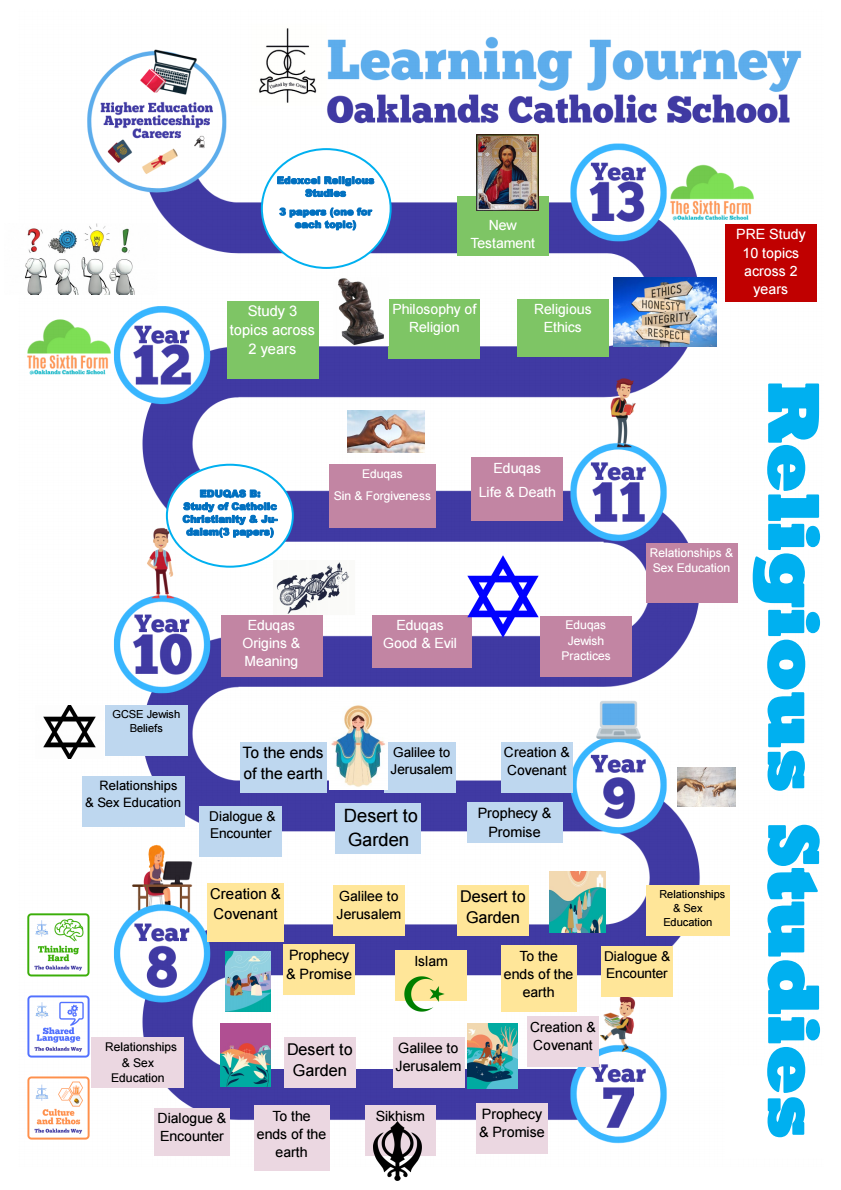
We aim at deepening young people’s knowledge, understanding and effective appreciation of the Catholic faith tradition, of other religions and of contemporary religious moral and philosophical issues. Our curriculum is coherently planned and builds upon the programme used by Portsmouth Diocesan schools at Key Stage 1 & 2, developing increasingly detailed and varied knowledge about a range of traditions and faiths, including the Christian, Sikh, Muslim and Jewish faiths. We also recognise that some students have experienced a different curriculum at Key Stage 2, prior to Oaklands, especially if they come from a non-Catholic feeder school, and therefore core Christian beliefs and practices as well as essential thinking skills are taught early in the Key Stage 3 curriculum to ensure all student can access the learning.
Our curriculum is designed to build a student’s cultural capital, for example at Key Stage 3 students study the Sikh and Muslim faiths and Judaism at Key Stage 4. This enables them to be knowledgeable and tolerant members of an increasingly diverse 21st century society. Use of case studies from a range of cultures, historical periods and perspectives is an ongoing feature of learning in Religious Education. Moreover, they are regularly invited to share their opinions on ethical issues which in turn helps provide students with the cultural capital they need to succeed later in life.